Last week we attended Summit - the Community Based Research Centre (CBRC)’s annual conference on Canadian 2SLGBTQI+ health. The conference brings together researchers, service providers and community organizations to share ideas and shape research, services and advocacy. Founded in 2005 with a focus on HIV and sexually transmitted and blood-borne infections in 2SGBTQI+ communities, it now covers 2SLGBTQI+ health more broadly through workshops, panels, roundtables and keynote speakers from Canada and around the world. This year the conference’s theme was Building our Futures and it was held in Toronto from October 29th to November 1st.
Dr. OmiSoore Dryden: Credit CBRC & @jackiebrownphotography
The three-day conference was rich in learning and connections. A few of our highlights were:
Black 2SLGBTQI+ Liberation is a Practice: Knowledge, Health, Power, and the Futures we build. Dr. OmiSoore Dryden
Dr. Dryden opened the conference with a powerful keynote. She challenged institutions and advocacy organizations to consider how knowledge, resources and power are distributed, particularly when research and policy draw on the lived experiences of Black queer and trans communities. Dr. Dryden emphasized that these communities have long generated their own knowledge, care practices and strategies for survival, yet institutions often benefit from this expertise without transferring decision-making authority or resources back to the communities. Through examples such as anti-Black racism in blood donation policies and the unequal recognition of Black queer experiences in public narratives of 2SLGBTQI+ violence, she highlighted how anti-Black racism and whiteness continue to shape whose experiences are considered representative and whose are overlooked. For example, the murder of Matthew Shephard, a 21 year old American student at the University of Wyoming who was beaten, tortured, and left to die after a homophobic attack Shepard's murder brought national and international attention to hate crime legislation at both the state and federal level as well as inspiring a number of films, novels, plays, songs, and other works. Dr. Dryden compared this response to the equally brutal murder of Sakia Gunn, a 15-year-old Black lesbian who was fatally stabbed in a hate crime in New Jersey in 2003. There was minimal mainstream news coverage of Gunn's murder compared to the massive international attention received by Matthew Shepard's murder five years earlier. Dr. Dryden asked us - who do we mourn, remember, honour?
She also challenged institutions to look beyond the language of inclusion and examine the structures that maintain inequality, encouraging organizations to follow the money by asking who controls research funding, owns community data, receives recognition and ultimately benefits from the knowledge produced.
A key takeaway for us was the need for advocacy organizations to rethink how they approach decolonization, research, community engagement and allyship. Dr. Dryden emphasized that Indigenous dispossession and the enslavement of Black people must be understood together as central to Canada's colonial history, rather than treating Indigenous rights and anti-Black racism as separate issues. What does this mean in practice? Moving beyond consultation and advisory roles towards genuine shared decision-making, ensuring community members are compensated and credited for their expertise, and giving communities authority over how their knowledge and data are used. Importantly, Dr. Dryden reminded us that Black queer and trans lives should be understood beyond narratives of trauma, discrimination and health disparities, making space for joy, pleasure, rest, relationships, safety and freedom. Her keynote left us with an important challenge: “If nothing is relinquished, nothing can be redistributed.” Meaningful liberation requires more than acknowledging inequity; it requires institutions and organizations to relinquish power, resources and control so that Black queer and trans communities can shape their own futures.
“Sometimes people are in a room full of people who think they are helping, but they are the ones who are causing harm.”
Trauma-Informed Facilitation in 2SLGBTQ+ and Black Community Spaces. Prudence Ndiweni
We also attended an excellent workshop on trauma-informed facilitation led by Prudence Ndiweni, which explored (and modelled) how to facilitate safer, more affirming and inclusive spaces for Black and 2SLGBTQ+ communities. The workshop highlighted how trauma is often shaped by collective experiences of racism, homophobia, transphobia, displacement and systemic exclusion, and how spaces intended to offer support can sometimes unintentionally cause further harm. Ndiweni spoke about the challenges faced by people with intersecting marginalized identities, who may experience homophobia or transphobia in Black community spaces, and anti-Black racism in 2SLGBTQ+ spaces. This can make it difficult to find spaces where people feel fully understood, accepted and able to be themselves. She also reminded us that harm can feel particularly significant when it happens in spaces where people expect to find belonging and affirmation. Such experiences can also vary depending on someone’s support system. The feeling of “you don’t belong here” will land differently with someone who goes home and is held and affirmed by family compared to someone whose family agrees that they don’t belong. At the same time, she emphasized that there is no single story or experience within any community, and that these spaces can also be vital sources of joy, connection and resilience.
An important part of the workshop focused on understanding how trauma and lived experiences can influence how people show up and participate in group settings. Ndiweni introduced the concept of the window of tolerance, which describes the zone in which someone feels regulated and able to be present, engage and make choices. Outside this window, people may experience hyperarousal (such as anxiety, nervousness or heightened reactivity) or hypoarousal (such as feeling shut down, disconnected or numb). These responses can be influenced by someone's physical and emotional well-being, experiences and support systems. For example, a Black participant's frustration or distress may be misinterpreted as aggression rather than understood in the context of their experiences. As facilitators, it is important to recognize these different responses and consider how our approaches can either support or undermine someone's sense of safety.
The workshop also offered practical strategies that facilitators can put into practice before and during group activities. These included preparing participants in advance by sharing agendas, considering accessibility and ensuring practical needs such as transportation and gender-inclusive washrooms are addressed. Rather than imposing a set of rules, Ndiweni encouraged groups to establish shared agreements around respect, privacy, choice, non-judgement and self-care. Other important practices include using fictional examples rather than asking participants to disclose personal trauma, always offering the option to pass on activities or questions, and being transparent that confidentiality has limits while encouraging people to respect what is shared in the room. Participants should also have different ways to engage, whether by speaking, taking notes, listening or stepping away when needed.
One particularly valuable reflection invited us to consider one sign that tells us when we are becoming unsettled and one action that can help us regain our steadiness, such as getting a glass of water, slowing down a conversation or taking a moment to orient ourselves to the room. Ultimately, the workshop reminded us that trauma-informed facilitation is not just about responding when harm occurs; it is about the small, intentional decisions we make to support people's dignity, autonomy and sense of belonging.
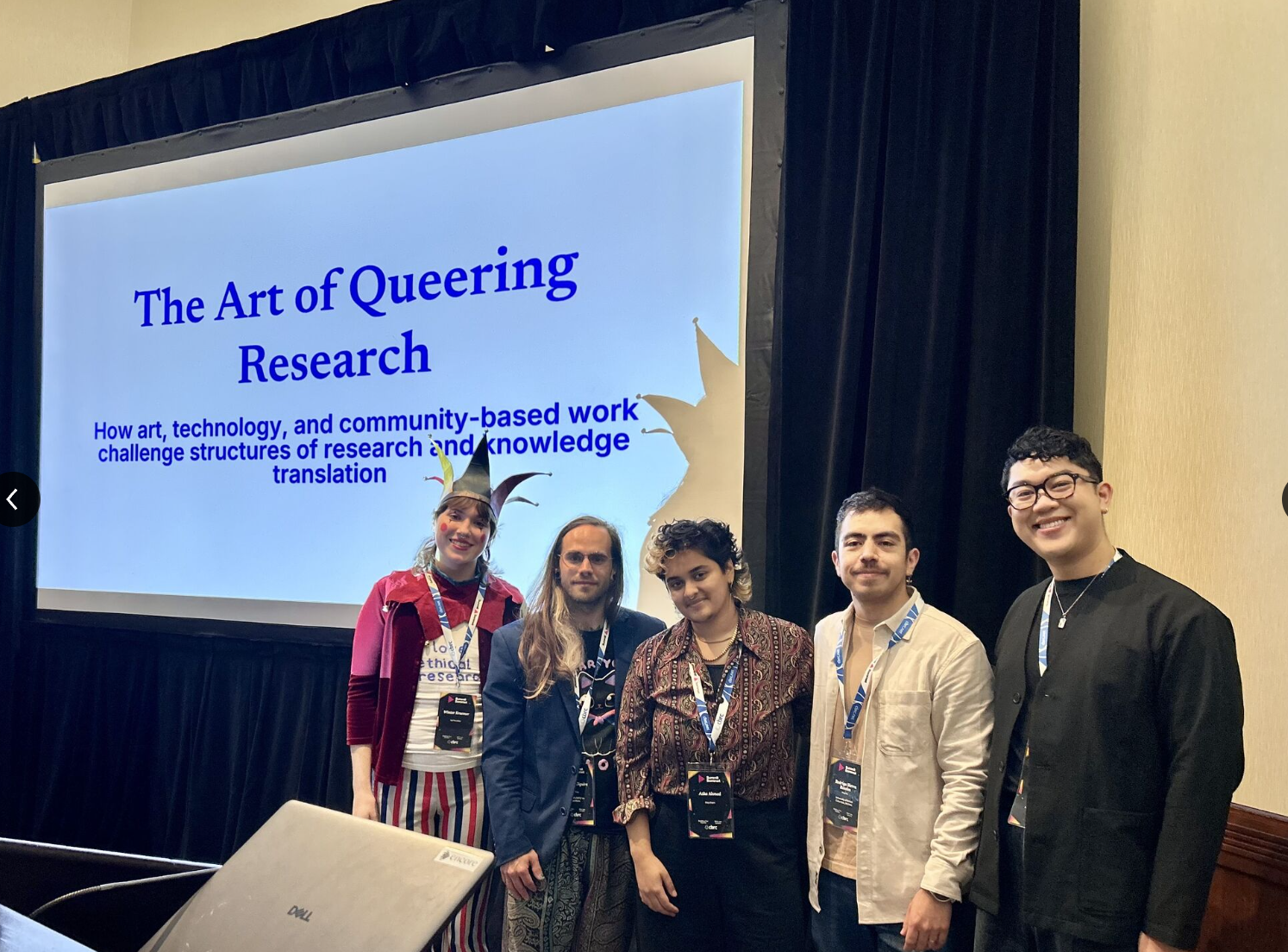
Winter Kraemer, Maxe Giguere, Azka Ahmed, Rodrigo Sierra-Rosales and Thomas Tri: Credit Winter Kraemer
The Art of Queering Research - How art, technology, and community-based work challenge structures of research and knowledge translation. Winter Kraemer, Maxe Giguere, Azka Ahmed, Rodrigo Sierra-Rosales, Thomas Tri.
This session explored how arts-based, creative and community-led approaches can challenge traditional research structures, redistribute power and make knowledge more inclusive and accessible. Through several examples, speakers demonstrated how art can capture experiences and emotions that traditional text-based research may not fully convey. Thomas Tri shared an arts-based engagement ethnography project exploring gender-based violence among newcomer 2SLGBTQIA+ youth, where participants created artwork, took part in interviews and focus groups, and shared their work through community exhibitions. An important aspect of the project was challenging institutional control over research data, with the community organization ultimately retaining ownership rather than the Research Ethics Boards of universities. Rodrigo Sierra-Rosales demonstrated the use of found poetry to explore healthcare providers' experiences working with trans, Two-Spirit and non-binary youth, showing how poetry can communicate complex emotions and experiences that may otherwise be lost in conventional academic writing. Winter Kraemer highlighted the lack of diversity and representation in traditional medical illustration, sharing their development of an interactive, inclusive patient education website featuring customizable illustrations for gender-affirming surgery.
Azka Ahmed further explored how research and knowledge translation can be reimagined through art, gathering and community-building. Their Inviting In project uses portrait photography to celebrate BIPOC gender-diverse individuals reclaiming visibility, self-representation and joy in the face of erasure. Collectively, these presentations challenged the assumption that research must be communicated through academic papers, reports or conferences, instead highlighting the value of exhibitions, poetry, visualizations and other creative forms of knowledge sharing. The session resonated strongly because it demonstrated how arts-based methods can create more relational, affirming and accessible research experiences while redistributing power to the communities whose knowledge and experiences are being represented. As researchers who are relatively new to these approaches, seeing the range of possibilities was both inspiring and valuable.
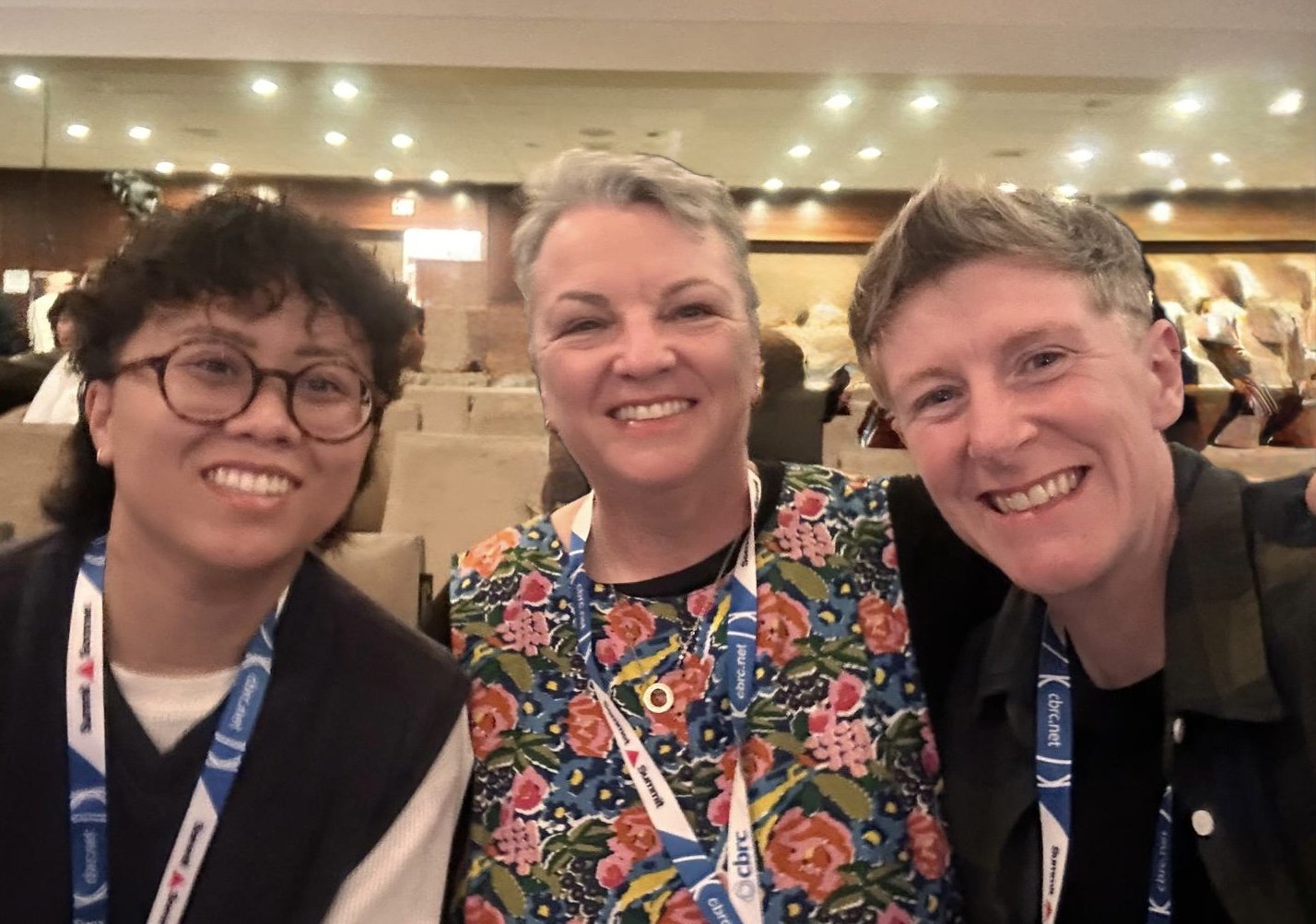
We were excited to share some of Queering Cancer’s work at the conference. Kim shared our TRANSforming Gyne Cancer Care project and we also participated in a keynote panel discussion with Dr. Jean-Marc Bourque (CHUM and Oncodiversitie), Lane Bonertz (Two-Spirit program at CBRC), and Thanh Nguyen (QC’s community partner) where Amanda gave an overview of the history and work of Queering Cancer and Thanh shared about their experiences navigating diagnosis and treatment of thyroid cancer while managing identity, disclosure and relationships. Kim also presented at the 2SLGBTQ+ Health Hub trainee showcase on November 28th.
We connected with so many great folks over these few days. As well as making new friends, some of our online connections were cemented when we met in 3D! This conference is uniquely rooted in community. We left with new knowledge, ideas and approaches to bring into our work, but above all, a renewed sense of connection to others who share our values and belief in what is possible when community, love and stories are centred.
What’s more, this conference had an incredible closing ceremony which included wisdom from Two-Spirit Elders, drumming, and DRAG! We are grateful to the CBRC and 2SLGBTQ Health Hub for the opportunity to attend and bring attention to inequities in cancer care.
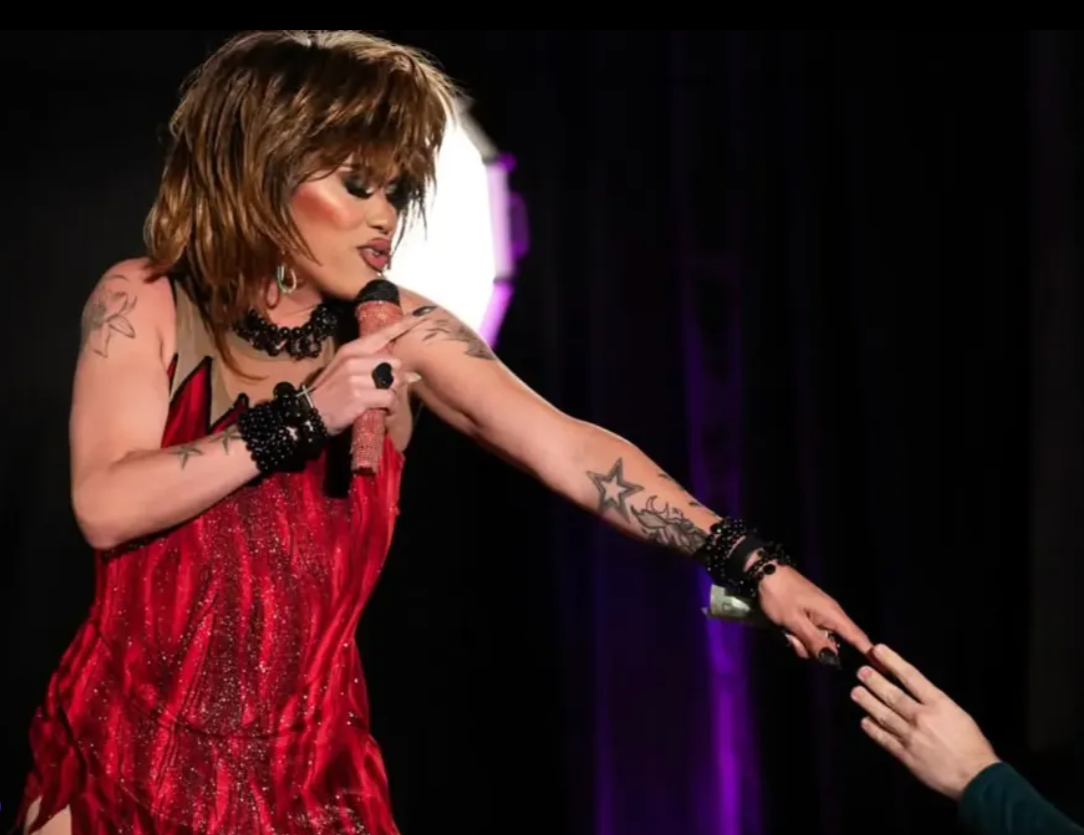
Ella Lamoureux: Credit CBRC & @jackiebrownphotography