
Community of Practice - Queering sex and pleasure in cancer care
Read a recap of our latest Community of Practice discussion (May 2026).

This Community of Practice session brought together healthcare providers and people with lived experience of cancer to explore what it means to take a queer, sex-positive approach to sex, intimacy, and pleasure in cancer care.
The conversation opened with Sarah-Jane, who shared her lived experience navigating gynecologic cancer care as a queer fat woman. She reflected on the absence of meaningful conversations about sex and intimacy, noting how silence from providers, narrow definitions of sex, and assumptions about bodies and relationships shaped her care.
“They actually cared more about me losing my hair, something that would eventually grow back, than they did over me losing parts of me so deeply linked to my sexual identity as a woman.”
Sarah-Jane also spoke to the lack of space to acknowledge and grieve changes to her body, desire, and experiences of pleasure absence that had physical, emotional and relational impacts.
Building on this, Dr. Kim Cullen (Clinical and Health Psychologist and Sex Therapist) contextualized why these gaps are so common, particularly for women, femme, and queer patients. The discussion explored how patriarchy continues to deprioritize female sexuality, especially queer sexuality, within healthcare.
Kim highlighted how cisheteronormative clinical frameworks shape both the knowledge base and the questions that are asked (or avoided), often centring penetrative cis-het sex, while excluding a broader range of experiences. Stigma, shame, and discomfort held by both providers and patients, were identified as key barriers, alongside deeply internalized taboos that make these conversations feel difficult to initiate or sustain. Time constraints and uncertainty about clinician responsibility for having conversations are commonly reported by health care providers as barriers. It was also noted that sexual health and function are often more proactively addressed in prostate cancer care, highlighting a stark contrast with the relative silence experienced in gynecologic cancer settings. Moreover, when sex is addressed with women, conversations are generally centred on reproductive health, and pleasure is not considered a priority. Both speakers also reflected on how certain topics such as anal sex, solo sex, ostomies, and changes to bodies and identity are often avoided altogether, limiting opportunities for patients to process grief, adaptation, and possibility.
The conversation then turned to the impact of creating space. Sarah-Jane reflected on the significance and power of being asked about sex and intimacy. Even when concerns are not immediate or top of mind, being asked signals that these aspects of life are valid and worthy of attention. The responsibility on providers to initiate these conversations was positioned as a core part of care, with an emphasis on asking early and often, and not assuming that someone else has already done so.
Kim discussed the common fear of “opening Pandora’s box,” reframing this instead as an opportunity to hold space and normalize rather than to have all the answers. In the final part of the session, they both explored what it means to “queer” sex and pleasure in cancer care. This included expanding definitions of sex and intimacy beyond heteronormative and penetrative frameworks, and centering pleasure as a legitimate and important aspect of care. Kim and Sarah-Jane discussed the importance of making space for grief, using inclusive and open-ended language, and avoiding assumptions about bodies, identities, and relationships.
Breakout discussions offered participants an opportunity to reflect on the conversation, share examples from their own practice and lived experience, and begin to envision what more inclusive, sex-positive cancer care could look like in action.
Overall, the session underscored that addressing sex, intimacy, and pleasure is not an “extra” in cancer care, but an essential part of supporting people as whole, complex, and sexual beings.
On behalf of everyone who joined, we’d like to extend our deep gratitude to Sarah-Jane and Kim for steering us through this topic with gentleness, honesty and expertise.
Resources and further reading
Sarah-Jane’s story - Queering Cancer
Sex and Cancer - OUTpatients
The PLISSIT model (a method for introducing sexual health into the clinical conversation).
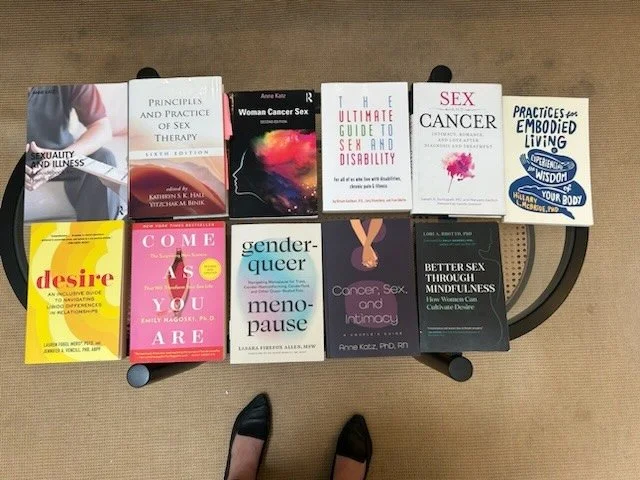
PLUS Kim C’s recommended reading (not all explicitly queer / or cancer related but generally inclusive).
Come as you Are: The Surprising New Science that will Transform your Sex Life by Emily Nagoski
Better Sex through Mindfulness by Lori Brotto
Genderqueer Menopause by Lasara Firefox Allen
Principles and Practices of Sex Therapy Edited by Hall and Binik
Breaking the Silence on Cancer and Sexuality: A Handbook for Healthcare Providers by Anne Katz // anything by Anne Katz
Thank you to everyone who joined us. We hope the session resonated with you and that you’ll continue to be part of this growing community. Our next gathering will be held on July 31st 2026. Let’s keep the conversation going.