Community of Practice - Centring queerness in cancer care
Read a recap of our latest Community of Practice discussion (January 2026).
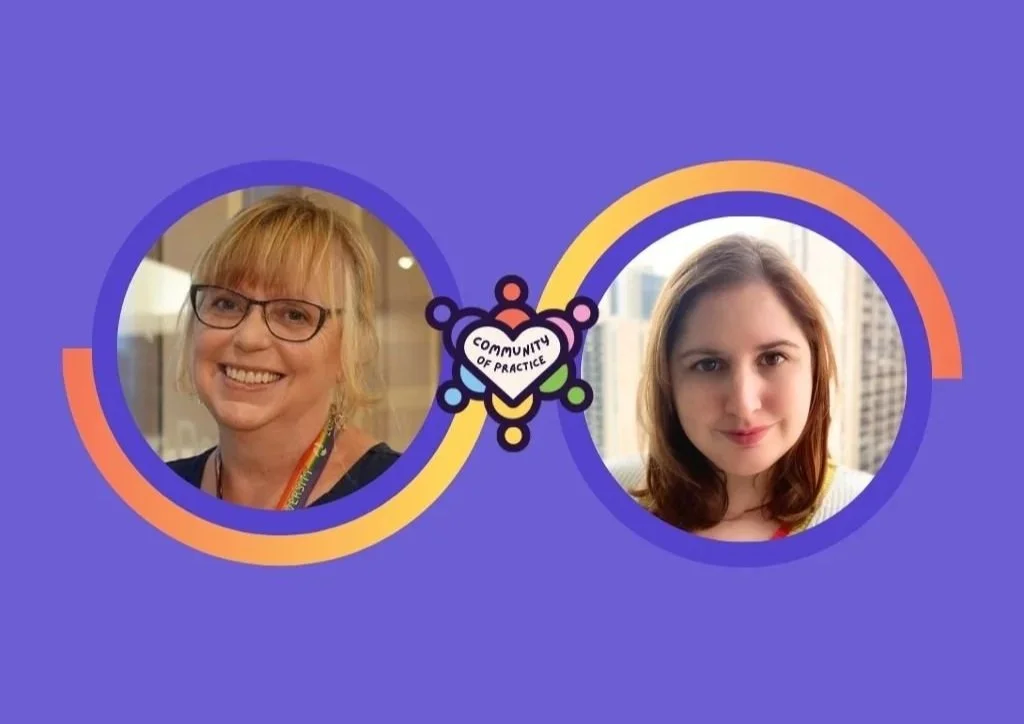
Our second Community of Practice gathering featured a conversation between Margo Kennedy (she/her), an oncology social worker at Princess Margaret and founding member of Princess Margaret Cancer Centre’s Sexual and Gender Diversity and Cancer Care (SGDC) Program, and Dani Taylor (she/her), a queer oncology social worker at Young Adult Cancer Canada (YACC) with lived experience of cancer, moderated by Alphonse Daniel (he/him), a social work student with the SGDC Program.
The discussion explored what it means to centre queerness in cancer care, how queer-specific supports emerge and are sustained, and how this work nourishes both patients and providers.
“Centring queerness means people don’t have to check their sexual orientation or gender identity at the door. They get to bring their full, glorious selves into cancer care - and that’s where real connection starts.”
Margo framed centring queerness as fundamentally shifting how care is conceptualized and delivered. Rather than fitting queer patients into cis-heteronormative models, queerness becomes foundational to connection, care, and understanding. This approach rejects assumptions and emphasizes intersectionality, recognizing that people bring their full identities, not just a cancer diagnosis, into care spaces. Centring queerness means creating environments where patients do not have to leave parts of themselves at the door and where authenticity, belonging, and trust are actively cultivated. Margo also highlighted the importance of providers leading with their own queerness as a way of signaling safety and solidarity.
Dani expanded this by emphasizing that queering cancer care improves care for everyone. She described queerness as bringing curiosity, play, critical thinking, and a willingness to challenge rigid biomedical norms. A central focus is storytelling… whose stories are told, whose are absent, and how dominant cancer narratives can intensify isolation for those who do not see themselves reflected. Centring queerness in cancer care involves disrupting these narratives and making space for more diverse, community-rooted stories.
Dani described the genesis of queer supports at YACC as deeply community-led. Queer peer support programs emerged from volunteers and survivors responding to unmet needs, particularly during the COVID-19 pandemic. Over time, challenges such as sustainability, volunteer burnout, and emotional labour required scaling back and restructuring programs to prioritize consistency, care for facilitators, and long-term viability. A key learning was the importance of community-centred (rather than “patient-centred”) approaches, grounded in social justice values and ongoing feedback from participants. While queer-specific spaces remain essential, this work has also “queered” broader programming, resulting in more inclusive and affirming spaces overall.
“Queering these spaces is just better for everybody. It pushes us to ask ‘why,’ to tell different stories, and to create care that feels less isolating and more human - for queer folks and for everyone.”
Margo reflected on building queer supports within a large cancer centre. The SGDC program grew from shared vision, trust-building, and patient stories that revealed a sense of not belonging in either mainstream cancer spaces or queer community spaces. The program evolved from environmental and educational changes to direct clinical support, navigation, and queer-specific groups. Accessibility, flexibility, and earning community trust are central, especially given historical harms in healthcare. The program intentionally centres queerness first, with cancer as a secondary context.
The discussion closed with reflections on sustainability and joy. Both Margo and Dani described how this work sustains them through community, creativity, gentle rebellion, and witnessing transformation, whether through queering institutional spaces, integrating queer culture into care, or finding connection with others doing this work. Ultimately, the conversation underscored that centring queerness in cancer care is collective, evolving, and deeply sustaining for everyone involved.
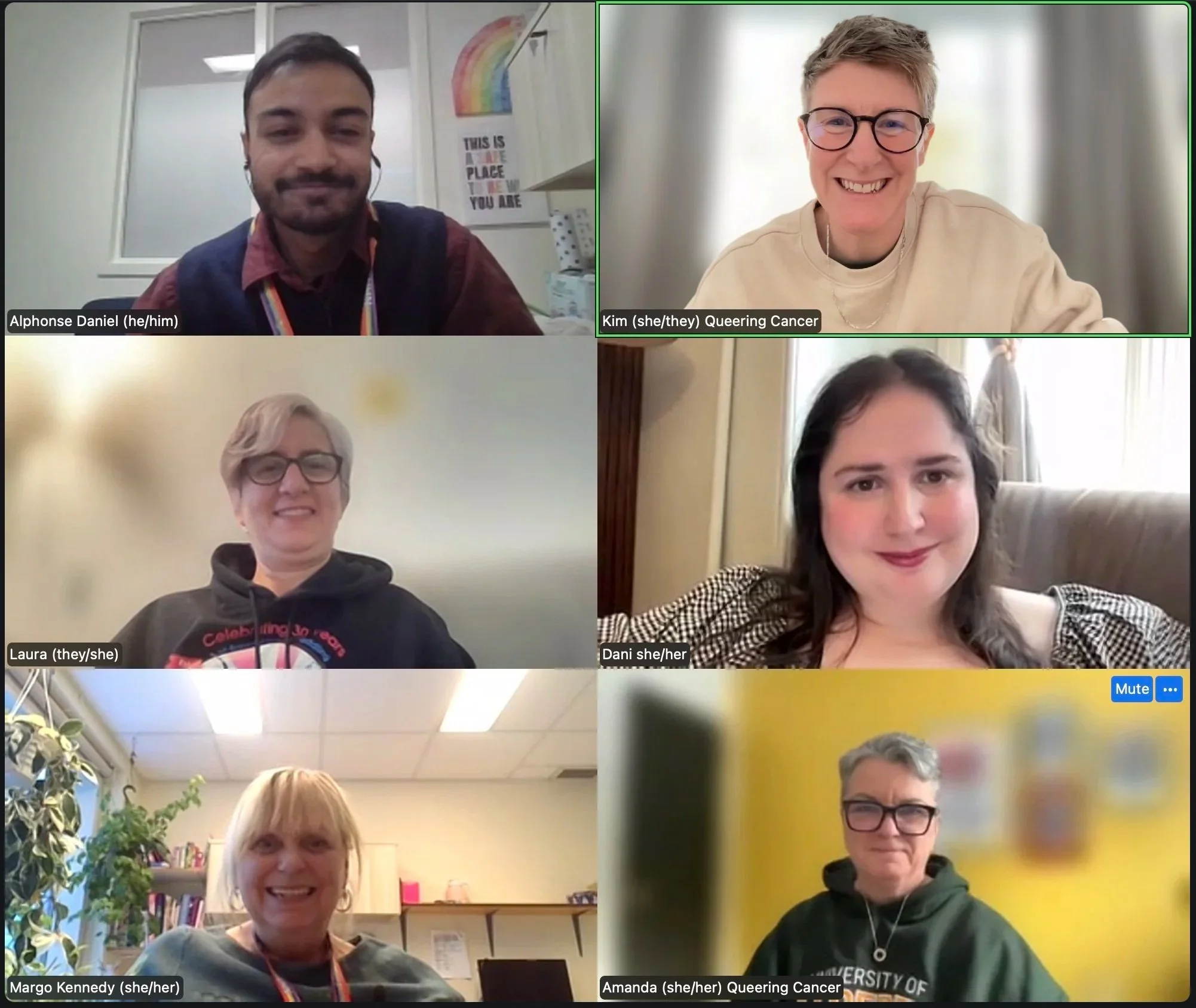
The team behind the latest Community of Practice gathering: Alphonse, Kim, Laura, Dani, Margo and Amanda
Thank you to everyone who joined us. We hope the session resonated with you and that you’ll continue to be part of this growing community. Let’s keep the conversation going.